Copyright, Interpretation and Performing Material
Copyright does not prevent anyone from interpreting a work. A conductor is free to make interpretive choices, whether the music is still under copyright or not. The question is different when those choices are written into a complete set of performing material and that material is published or sold: at that point, the issue is not the interpretation itself, but the practical possibility that my parts could be used instead of the original copyrighted material.
When I work on a score, I may add dynamics, articulations, bowings, fingerings, phrasing, tempi, corrections, comments and all the other indications which constitute my reading of the music. In the case of some works, this process can become extremely detailed. The work I’ve done on Stravinsky’s Danses concertantes is a good example. My working score contains a frankly embarrassing number of comments and annotations. I have compared analogous passages, questioned discrepancies between them, reconsidered accidentals which appear inconsistent with – for instance – the underlying octatonic language, and examined passages in relation to transpositions of the Petrushka chord and other structural elements of Stravinsky’s musical language. This is my interpretation of his music, written down in considerable detail. A violinist may put his or her own bowings and fingerings into a part; a pianist can annotate a score with phrasing, fingering and articulation; a conductor can make the same kind of decisions on a full orchestral score. The fact that the work is protected by copyright does not turn the interpreter into a passive recipient of the composer’s instructions. My indications are simply there because this is what I hear, what I understand and what I would do. Others may follow them or make different choices. That is precisely what interpretation is. The same principle applies to my more extensive editorial work. If I discover what I believe to be an error, an inconsistency or an impractical notation in an existing score, I may investigate it, document my reasoning and produce a working version which reflects my conclusions. The existence of the original edition remains unchanged; so does the copyright in the original work. And these two things can perfectly well coexist in practice. For the performance of Danses concertantes with the MiT Orchestra in Freiberg, for example, the authorised orchestral material was rented from the publisher, as required. At the same time, my own working score and my own performance material could be used by us in preparing and performing the work. The publisher’s material and my interpretation were not competing versions of the same thing. They served different purposes.
In practical terms, works are normally described as either still under copyright or in the public domain. In the European Union, copyright generally lasts for the lifetime of the author plus seventy years, with the term calculated from 1 January of the year following the author’s death. Once that period has expired, the work enters the public domain. Some well-known composers whose works have recently entered the public domain in the European Union include Arthur Honegger and George Enescu, whose works entered the public domain in 2026. In 2027, the same will happen to works by composers who died in 1956, including Reinhold Glière and Gerald Finzi; in 2028, it will include composers who died in 1957, such as Jean Sibelius and Erich Korngold. This also shows why the distinction matters in practical work. Composers such as Debussy and Ravel, who died much earlier, are already well within the public domain in the European Union. Others remain protected for many years to come. Igor Stravinsky, for example, died in 1971, so his works will remain protected in the European Union until the end of 2041 and enter the public domain on 1 January 2042.
The following catalogue always offers the score and the performing material I have carefully prepared. The PDF available on request via the INQUIRE button, or for DOWNLOAD where offered, contains only pages of music, without blank pages or additional pages devoted to titles and other score information. Should you require a customised version, simply specify what you need, and I will do my best to accommodate your request.
Where a work is still under copyright, the necessary rights and authorised performance material must of course be dealt with appropriately. But this does not prevent a performer from developing, recording and sharing his or her own interpretation of the work. Once a score is published and entrusted to performers, it enters a world of interpretation. The composer has written the work; the performer has the right to say what he or she hears in it. I consider that part of the life of a musical work.
Looking for something that is not yet in the catalogue?
Get in touch. I may already have something prepared, or we can see what might be possible.
CATALOGUE
Georges Bizet — Adagietto — Score
Georges Bizet — Adagietto — Score & Parts
Edward Elgar — Vesper Voluntary — Score & Parts
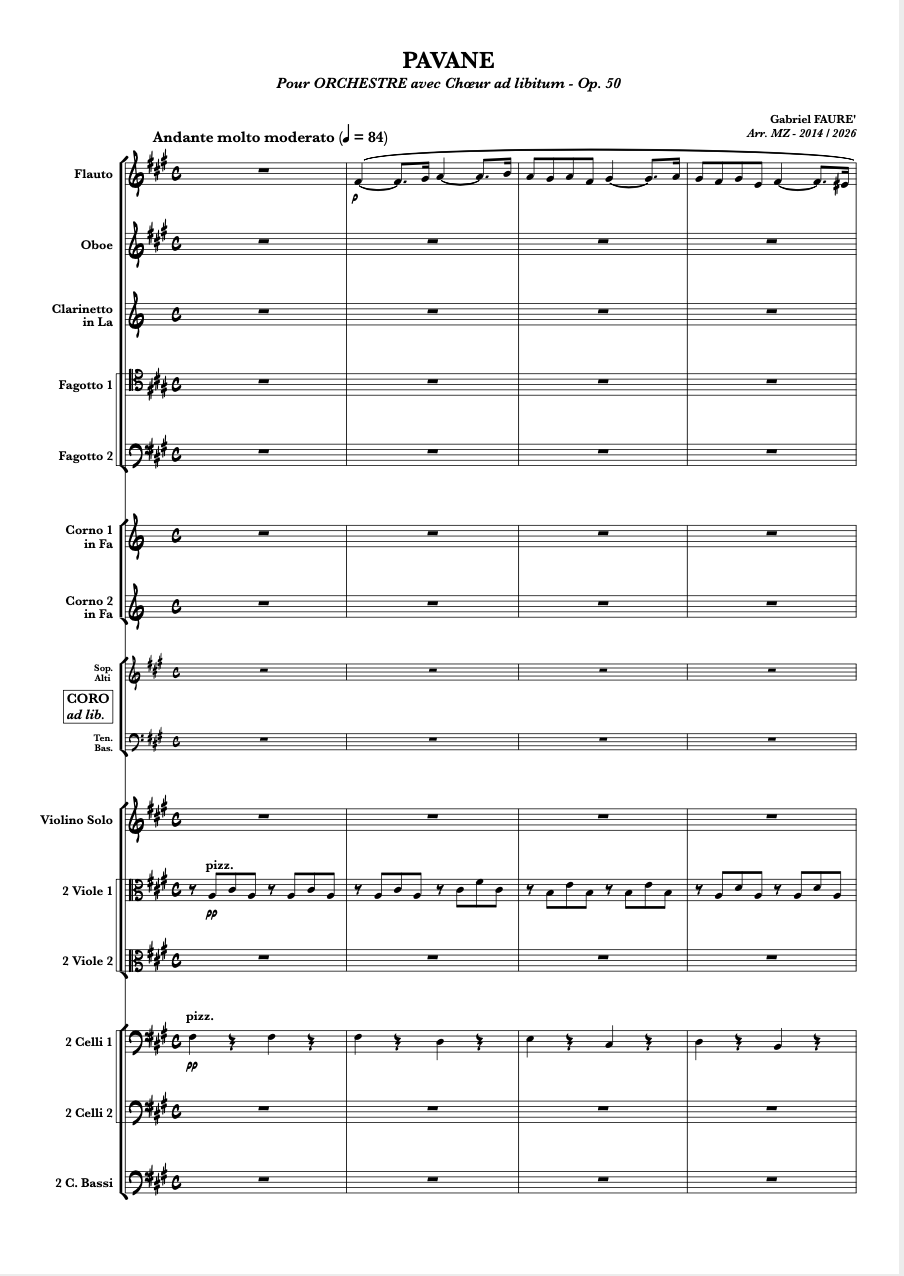
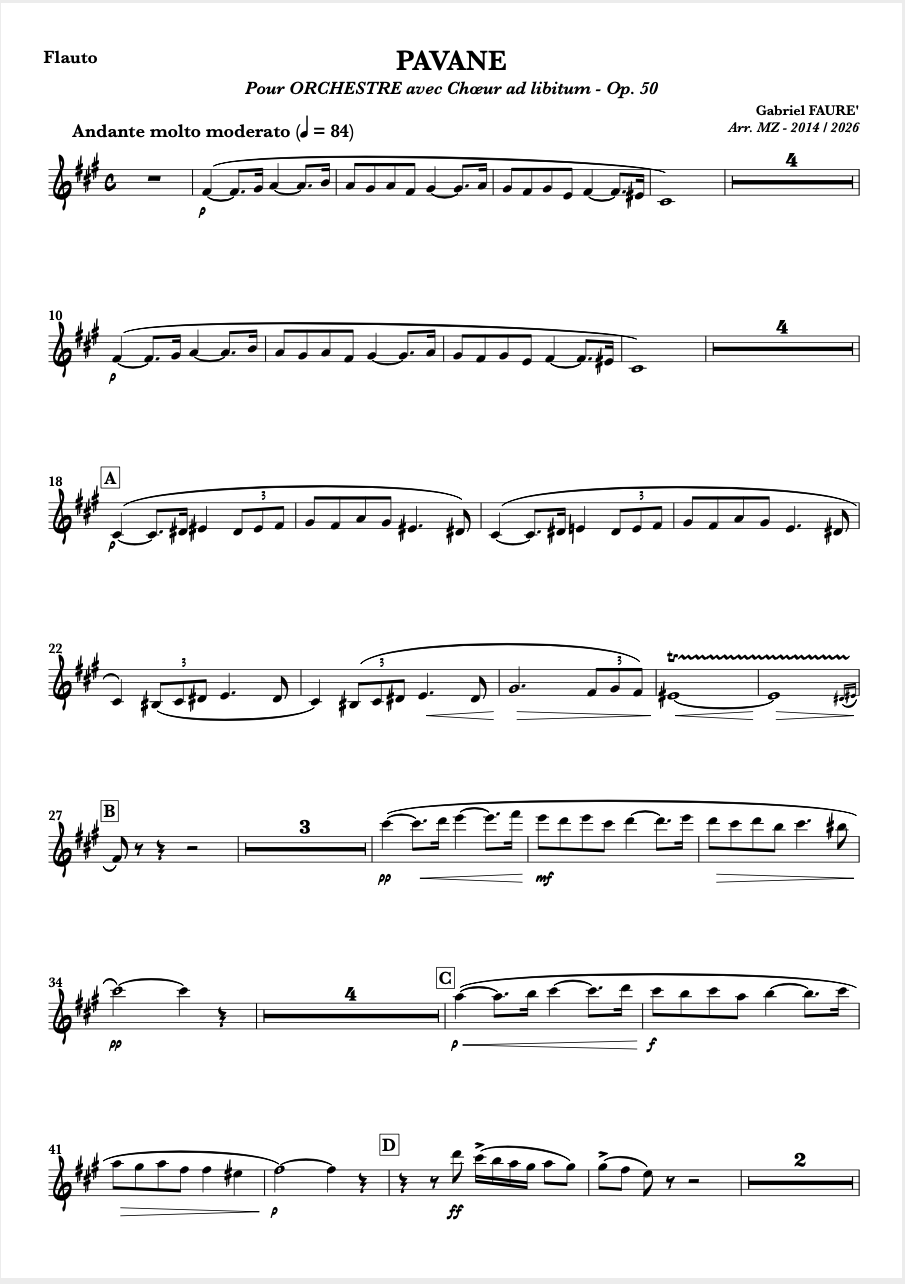
Gabriel Fauré — Pavane — Score & Parts
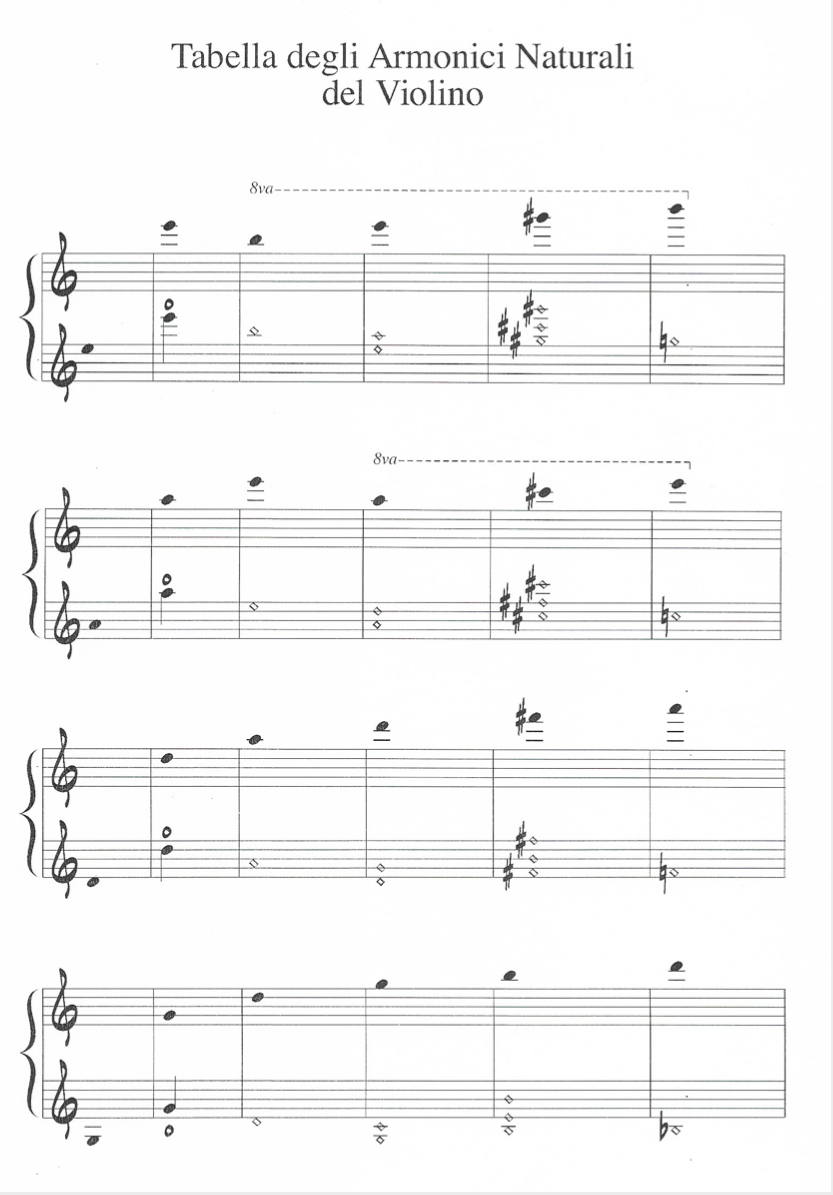
Natural Harmonics for Strings — Reference Chart
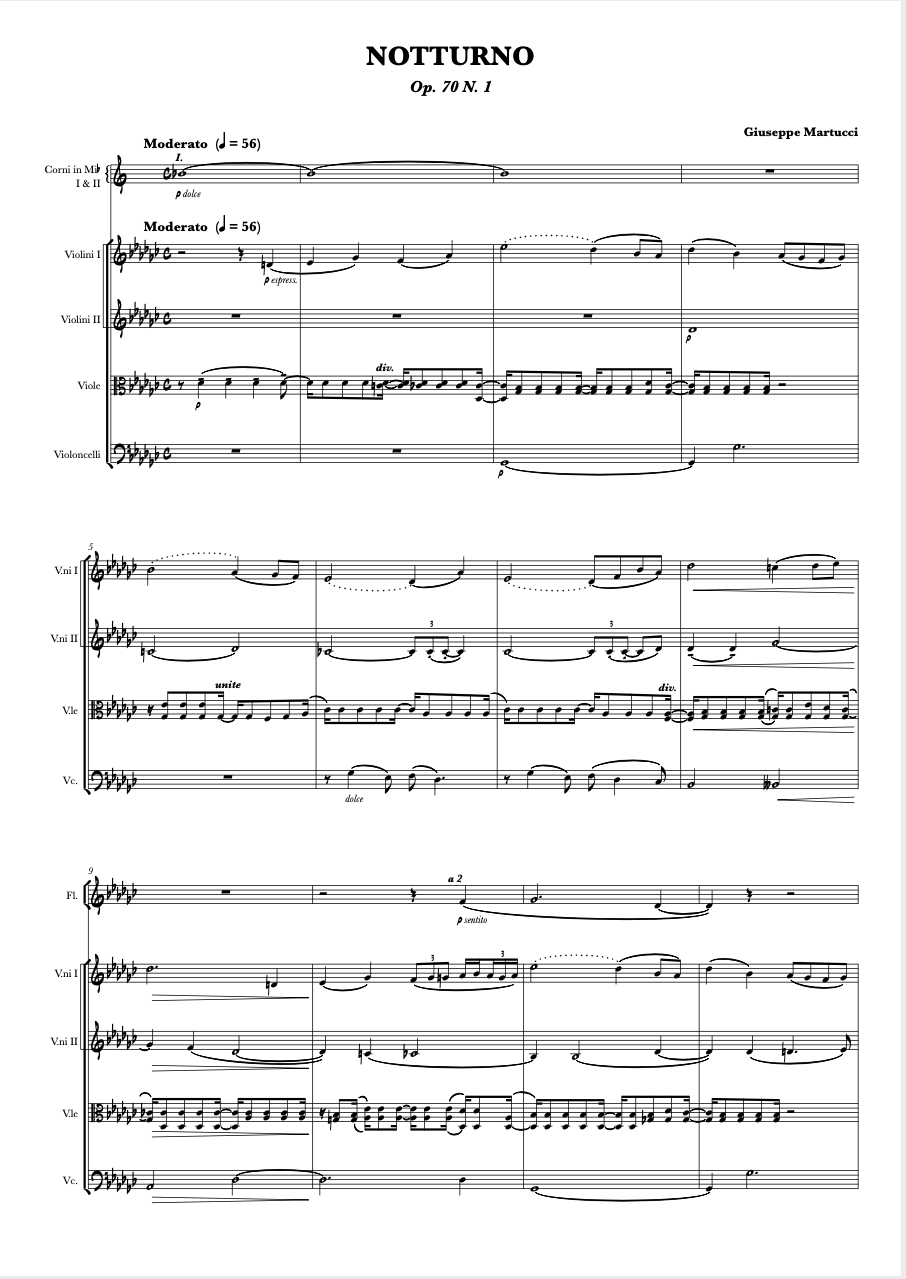
Giuseppe Martucci — Notturno — Score & Parts
Giacomo Puccini — Crisantemi — String Orchestra version
Licinio Refice — Ombra di nube — Voice & Strings
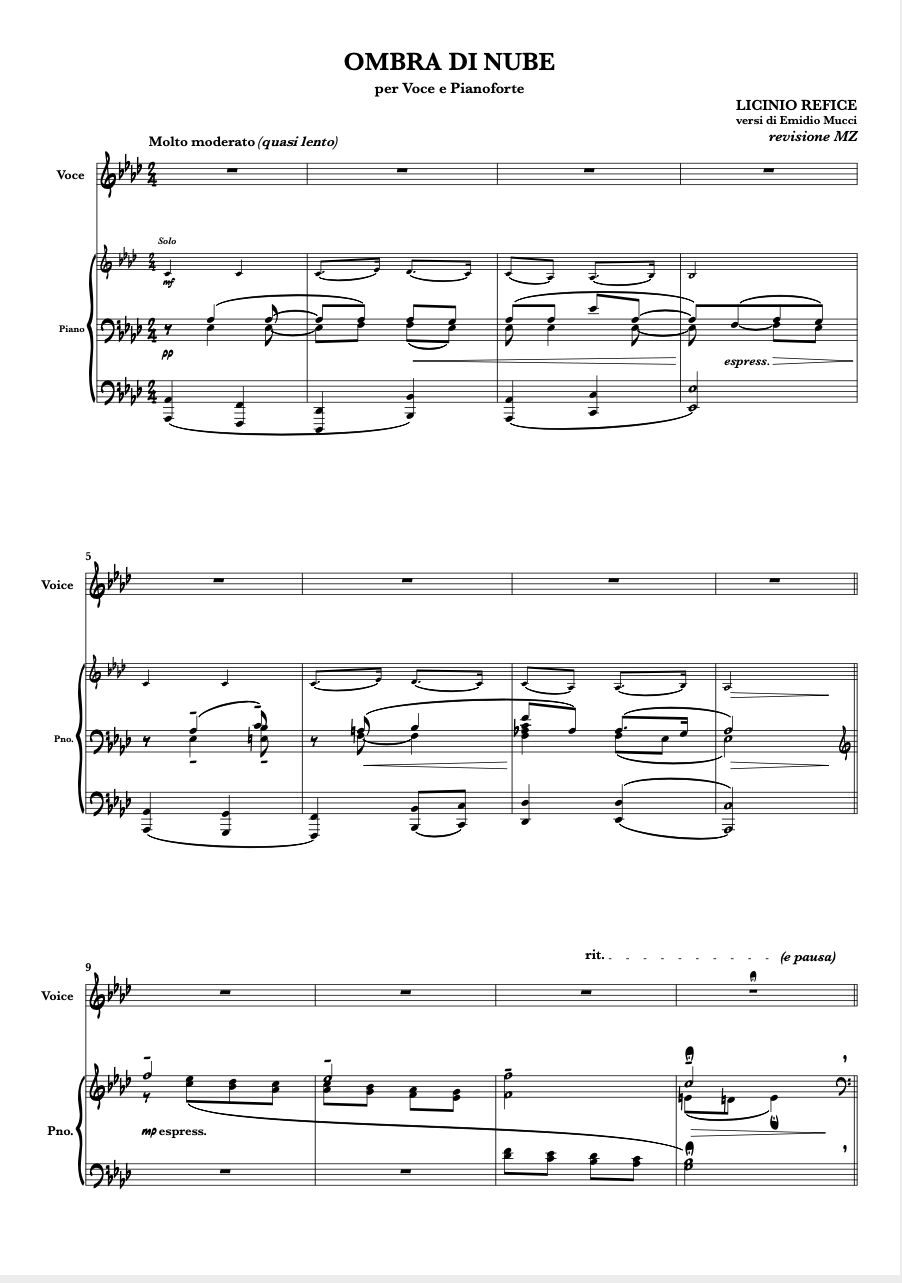
Licinio Refice — Ombra di nube — Vocal Score
Ralph Vaughan Williams — Rhosymedre — Score & Parts
Georges Bizet: Adagietto – Score
Adagietto from Georges Bizet’s L’ARLESIENNE Suite No. 1 for Strings. FREE DOWNLOAD
Georges Bizet: Adagietto
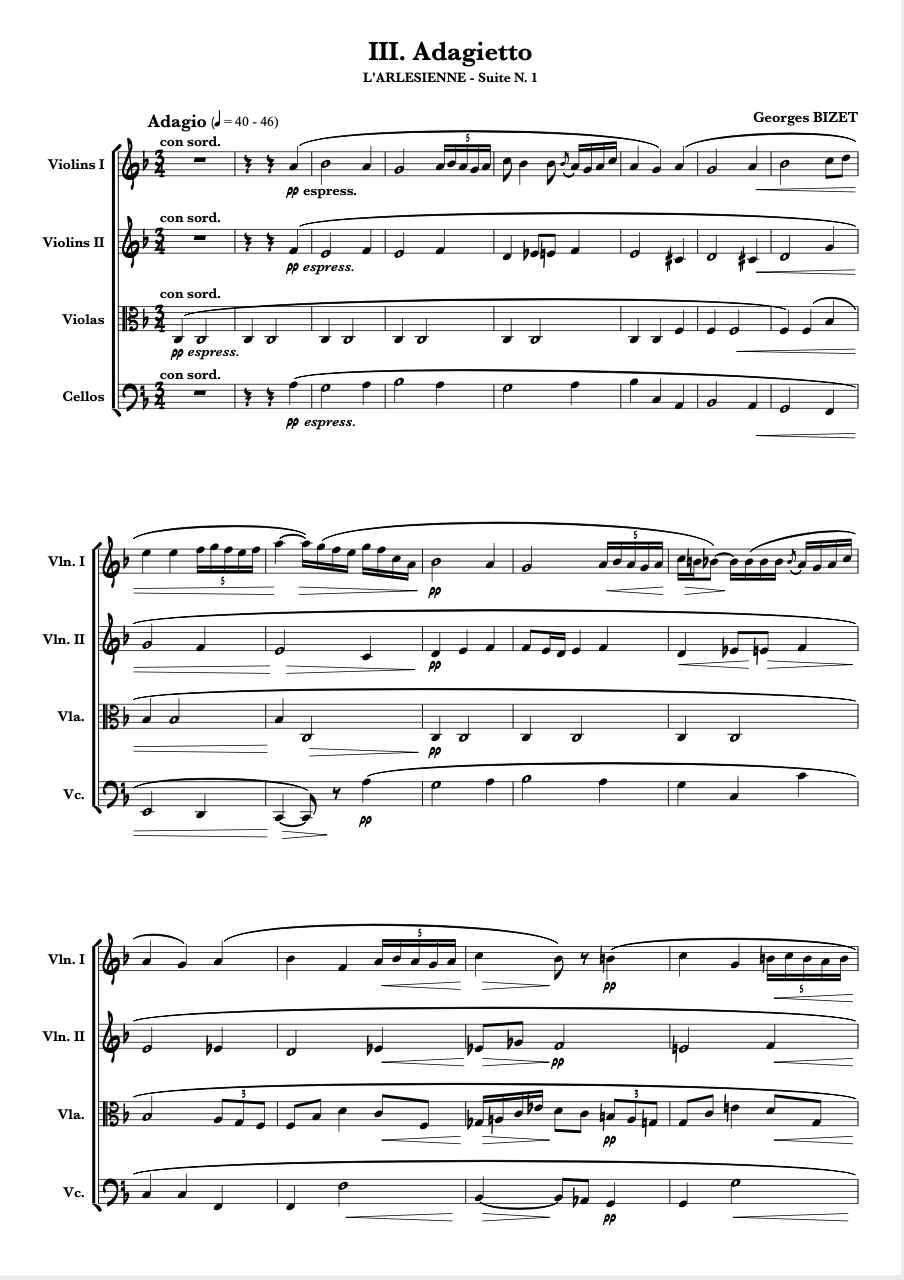
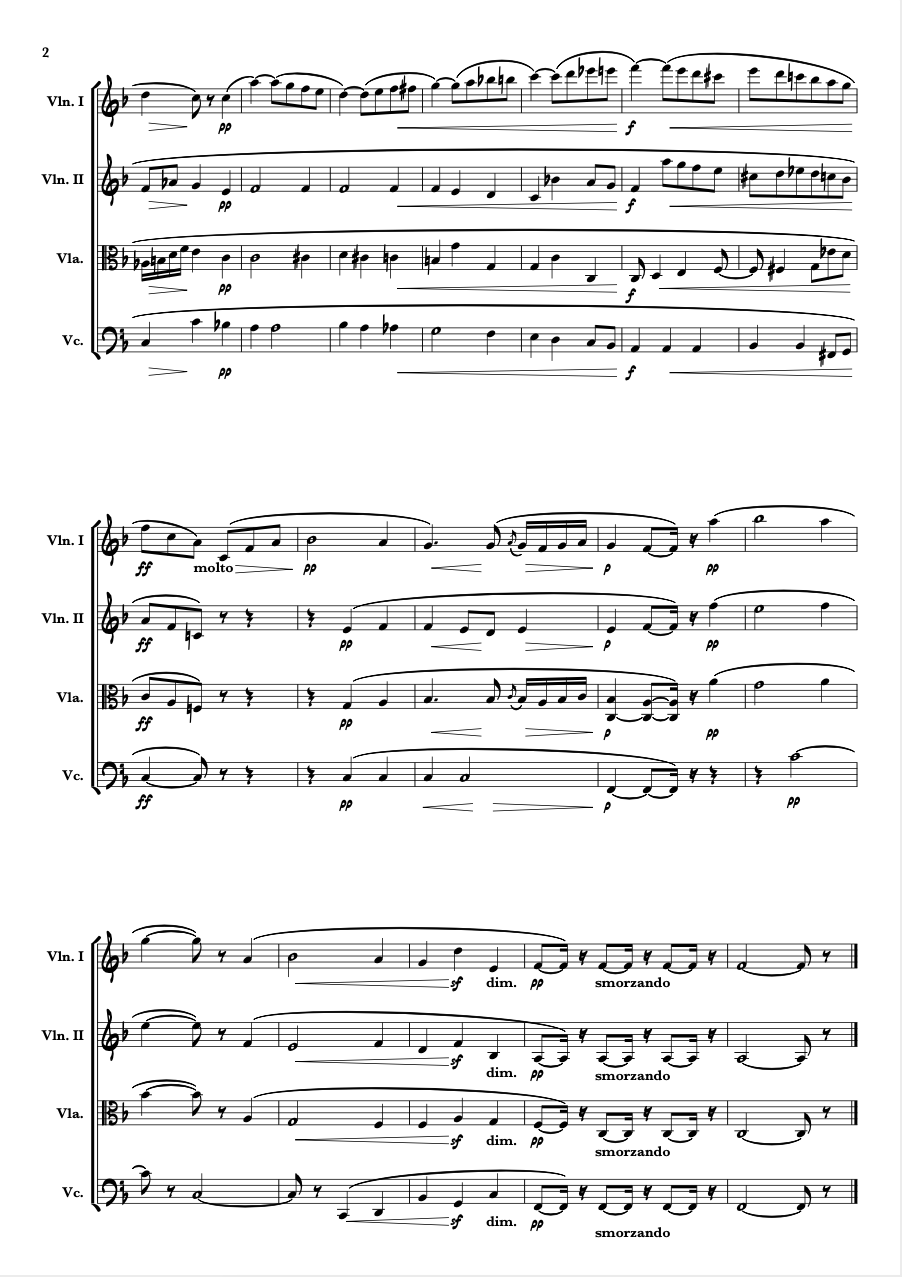
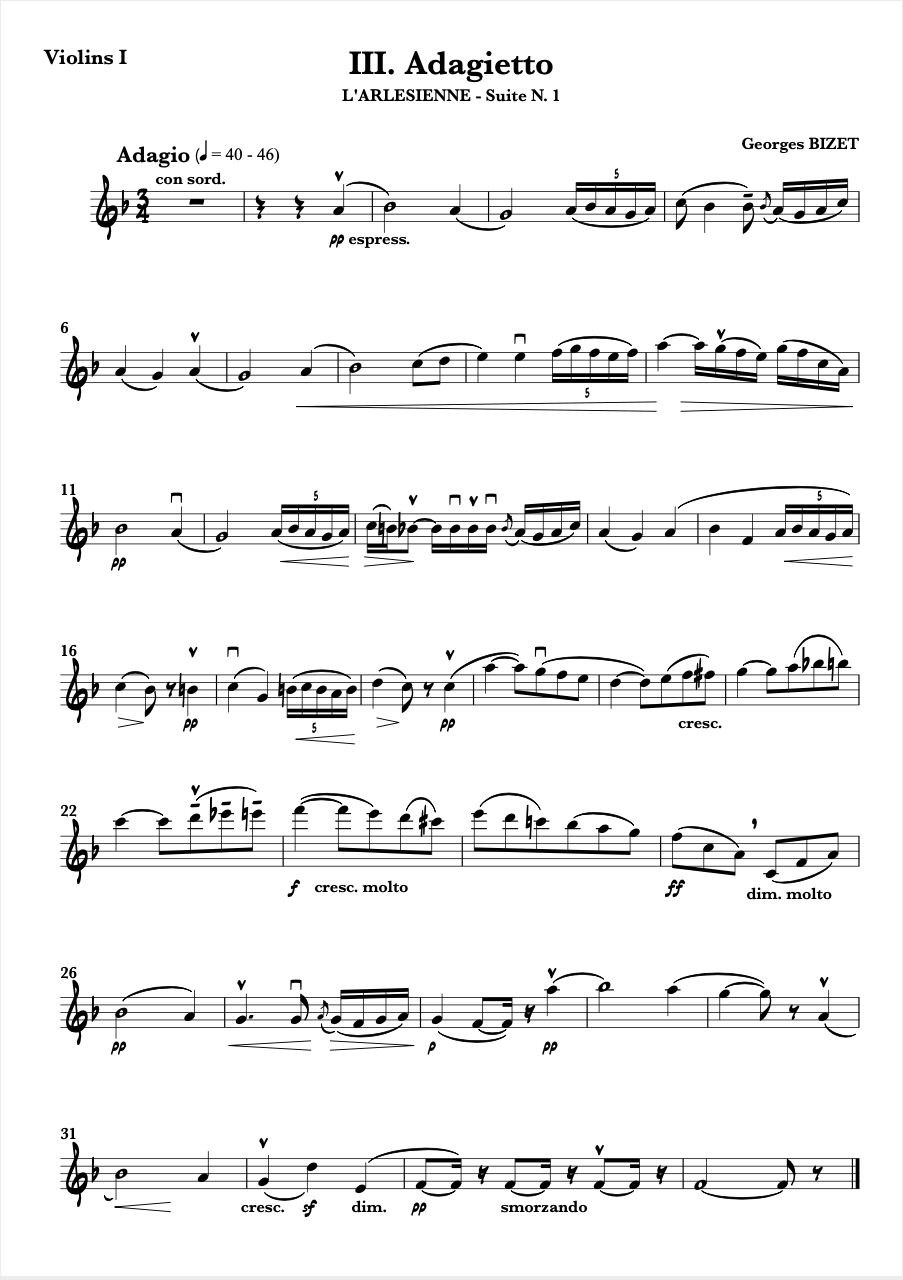
Adagietto from Georges Bizet’s L’ARLESIENNE Suite No. 1 for Strings. Bizet writes very long legato slurs over each part, which makes the indication rather impractical for the players. The separate parts are bow-marked in a way that makes his original indication genuinely playable for the string players.
Edward Elgar: Vesper Voluntary
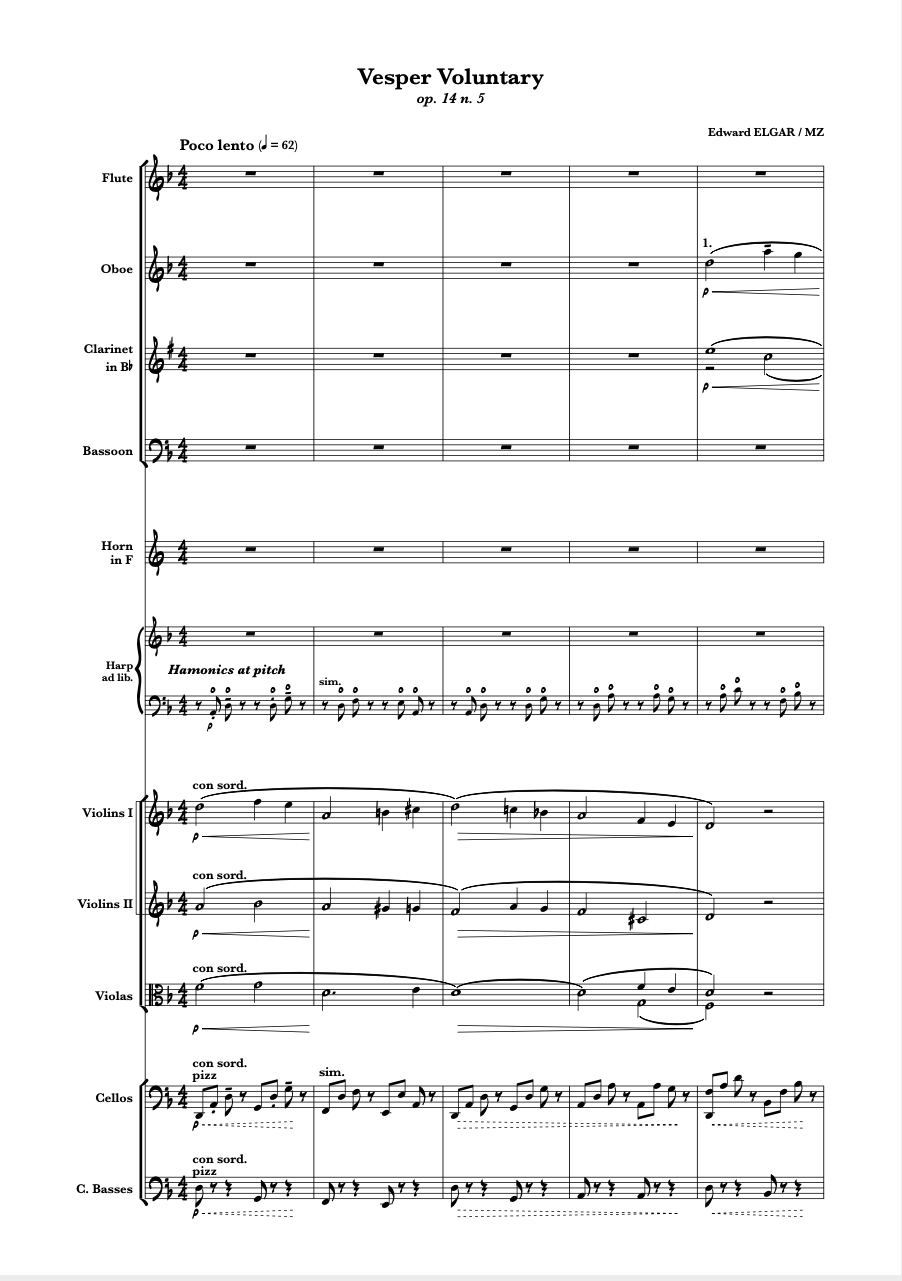
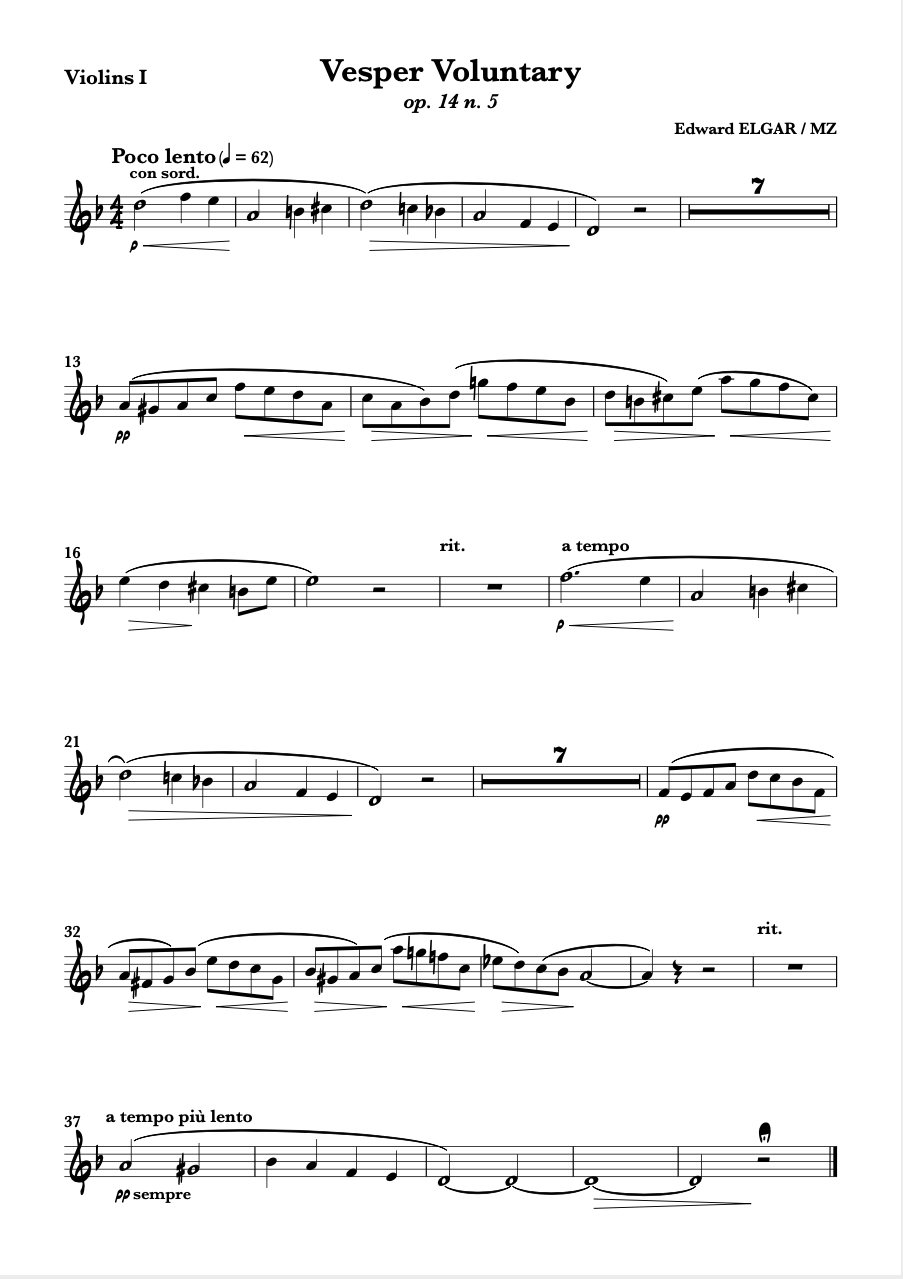
Edward Elgar’s Vesper Voluntary No. 5 Op. 14 is originally a work for organ. In this orchestration, I have tried to preserve the essentially organistic character of the sound plans while translating its textures into orchestral language.
I also find an interesting, if completely unexpected, affinity with Fauré’s Pavane in the ostinato pizzicato of the bass line. At just under three minutes, it is a little gem.
Gabriel Fauré: Pavane
This orchestration of Gabriel Fauré’s Pavane Op. 50 was originally conceived for a specific project with the Gonfalone in 2014 — a programme that also included the Requiem and Cantique de Jean Racine. The aim was to use the same string complement as in the chamber version of the Requiem (in our specific case: one solo violin, two desks of violas, two desks of cellos and one desk of double basses), naturally without organ or harp, adding flute, oboe, clarinet, two bassoons and two horns, with the choral part ad libitum.
That orchestration was based on the first published edition of the score. This year, having discovered that Fauré’s manuscript is also available online, I revisited the work and revised my orchestration by collating the manuscript with the first published edition, while retaining the same instrumental forces.
Natural Harmonics for Strings – Reference Chart
A four-page reference chart for the six natural harmonics commonly used in orchestral repertoire, showing their positions on the string instruments and their corresponding sounding pitches. The upper line shows the sounding pitch at the actual octave, including for the double basses. The lower line shows the corresponding position on the fingerboard.
The fourth harmonic has two possible positions, while the fifth has three. The sixth harmonic is very rarely written for the upper strings and is found regularly in Ravel’s writing for double basses. It is also a harmonic that is often played “by ear”, and therefore incorrectly, by orchestral musicians, making this chart particularly useful for conductors to know the exact sounding pitch when checking the accuracy of a performance.
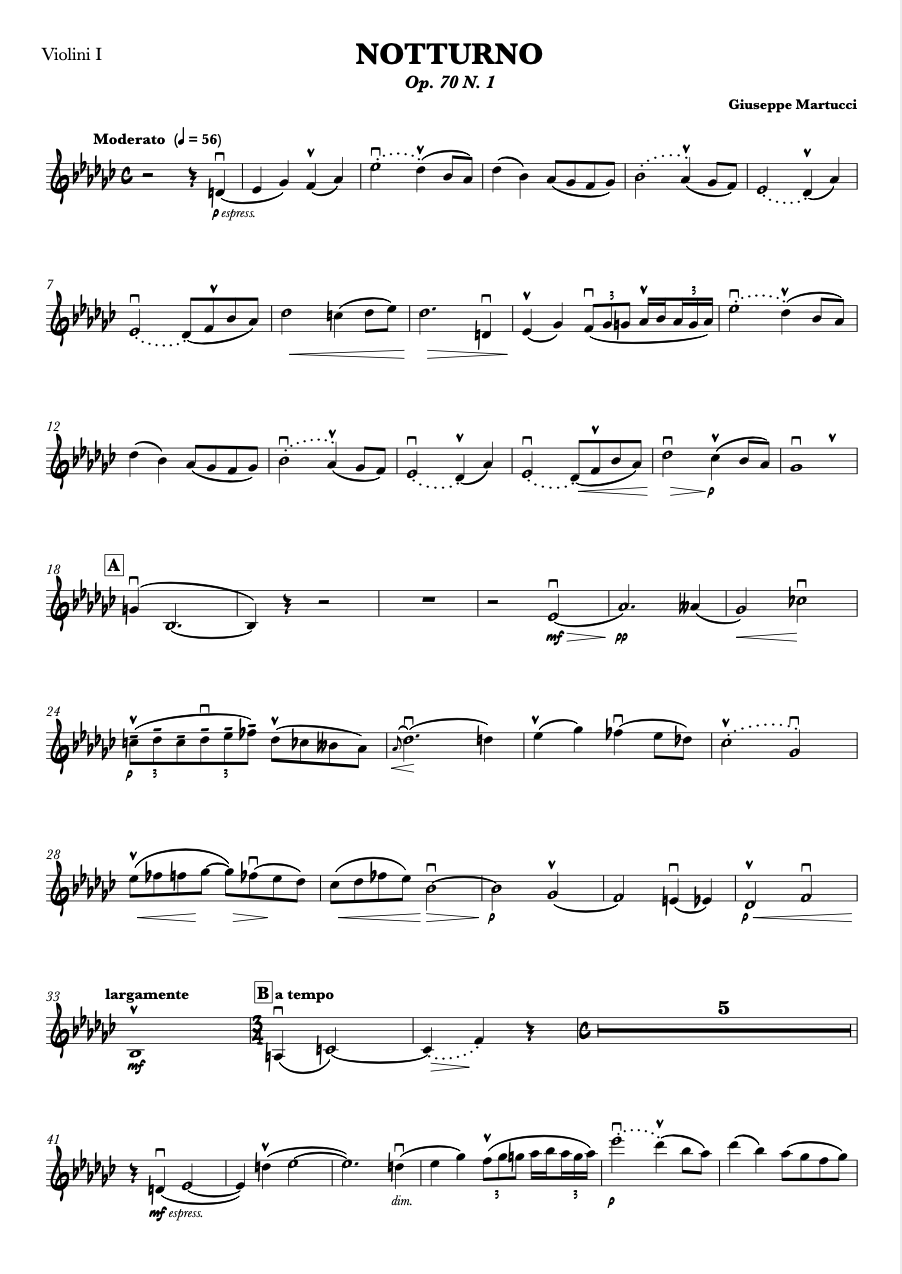
Giuseppe Martucci: Notturno
Notturno Op. 70 No. 1 by Giuseppe Martucci is the composer’s own orchestration of a work originally written for solo piano. A beautiful and relatively little-known piece, it is a remarkable example of purely instrumental Italian music. Martucci, a distinguished pianist and director of the Naples Conservatory, creates here an atmosphere that is delicately reminiscent of Mahler, with its crepuscular character and the warm, luminous tonality of G-flat major.
The orchestral parts are fully bow-marked.
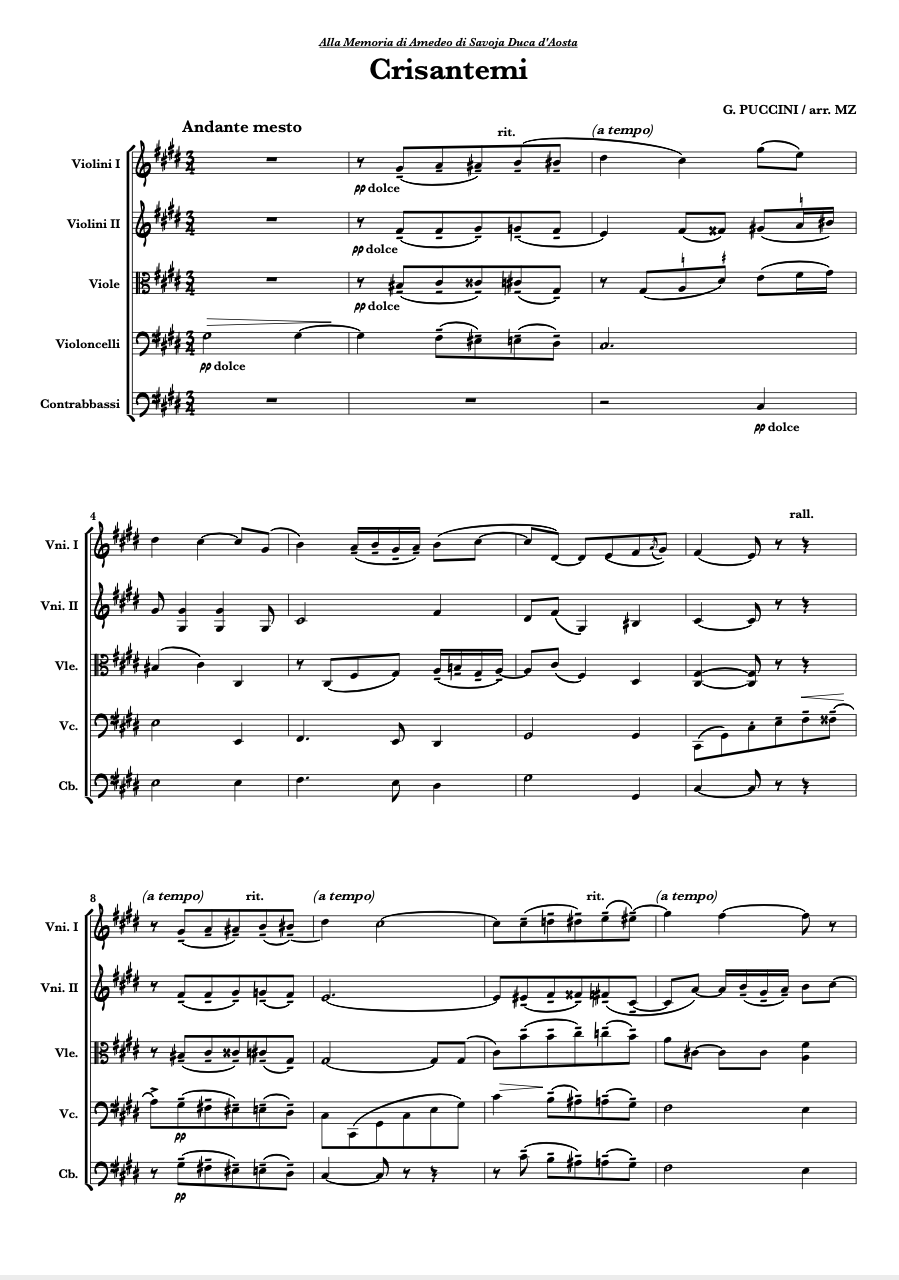
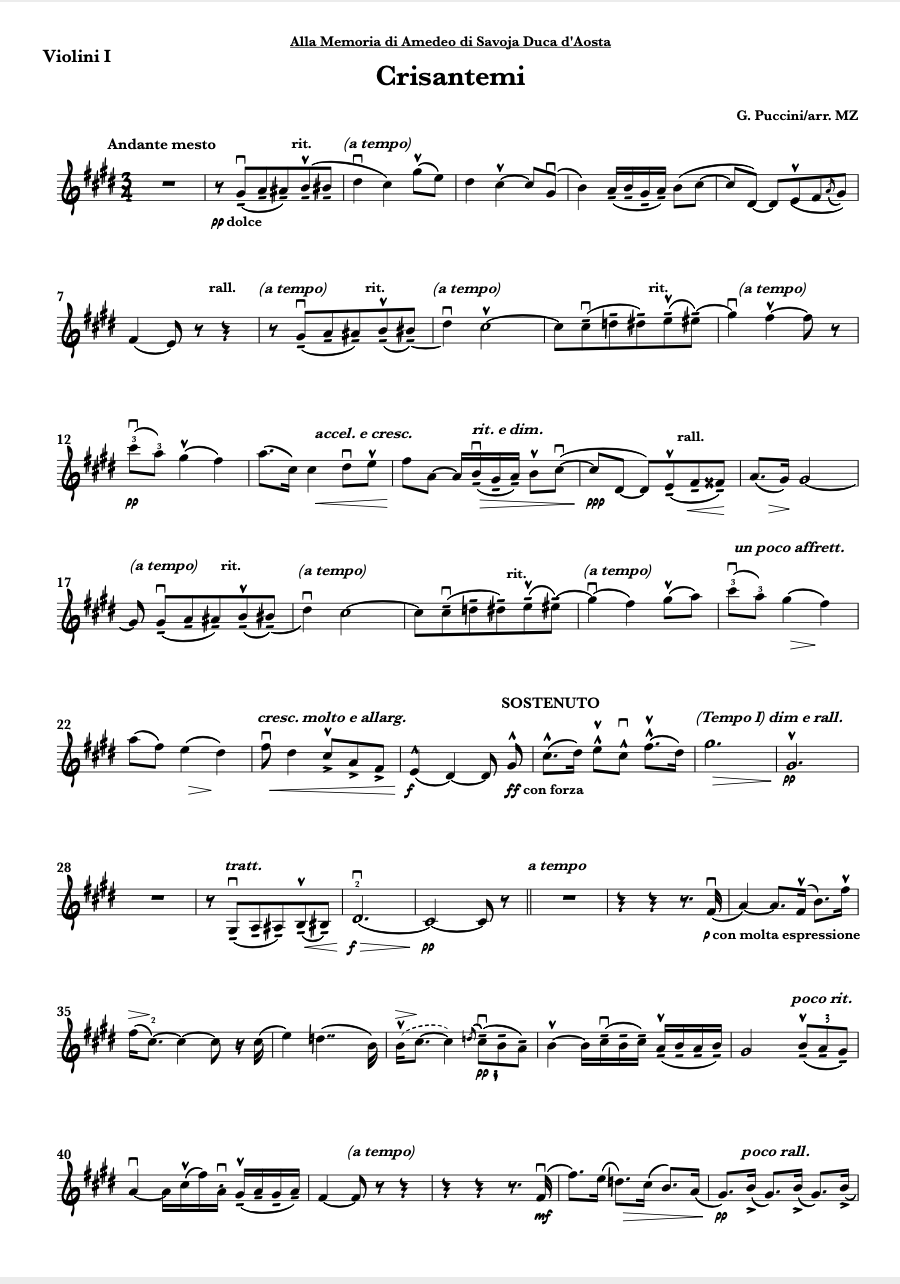
Giacomo Puccini: Crisantemi
The string quartet Crisantemi is one of the very few instrumental works by Giacomo Puccini to have entered the regular non-operatic repertoire. Its thematic material is extensively quoted in the fourth act of Manon Lescaut.
This is my arrangement for String Orchestra. The original quartet parts have been left completely untouched; I have simply added a double bass part and fully bow-marked the parts.
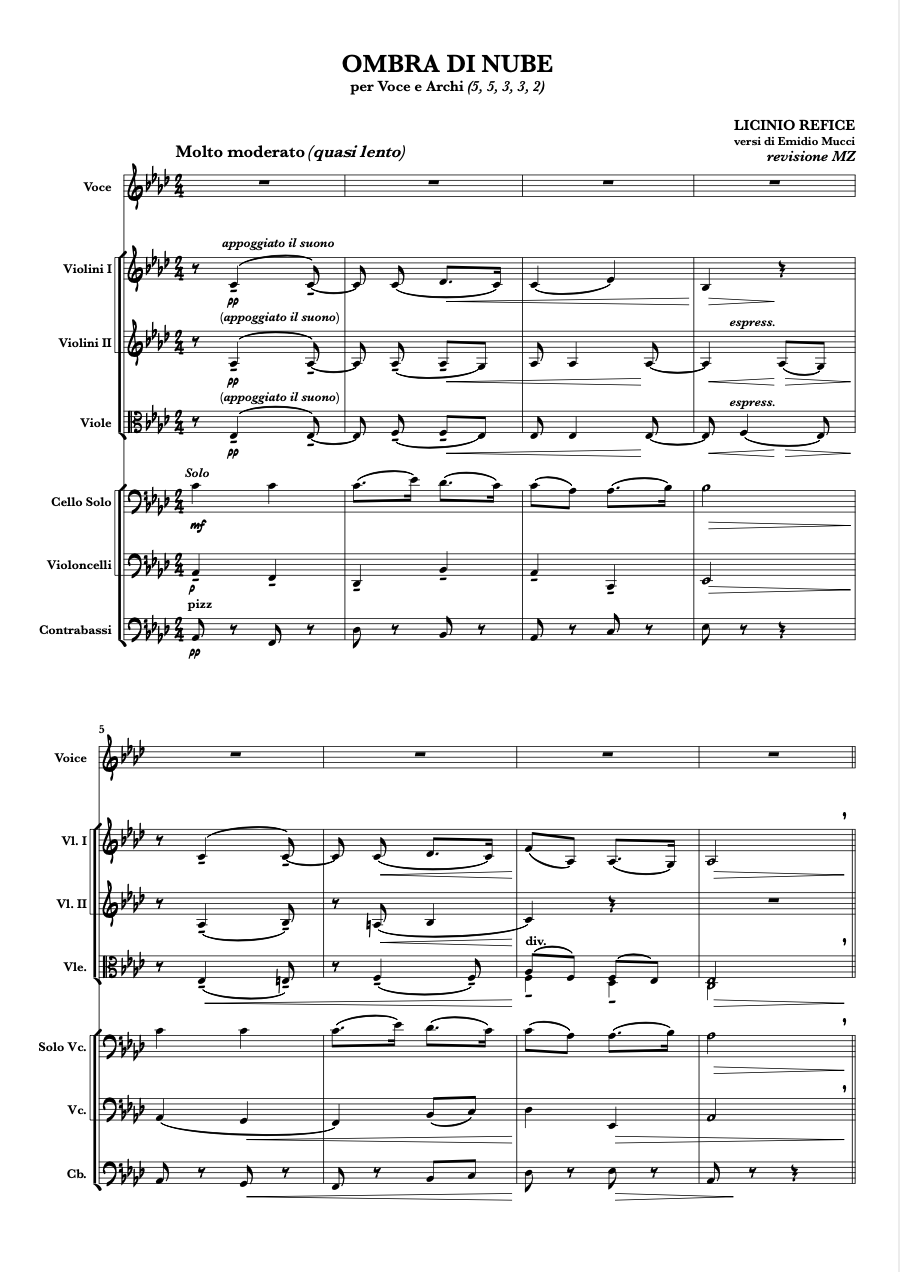
Licinio Refice: Ombra di nube
Ombra di nube by Licinio Refice is a song for voice and piano, written for soprano Claudia Muzio and subsequently orchestrated by the composer for strings. In his manuscript, Refice calls for a small string complement of 5, 5, 3, 3, 2, but his orchestration is full of divisi, mostly in the violas (of which there are only three!), while the first of the three cellos often plays Solo. My version, based on the only available printed score, aims to achieve a better balance in the redistribution of the divided string parts while preserving the essential character of Refice’s original.
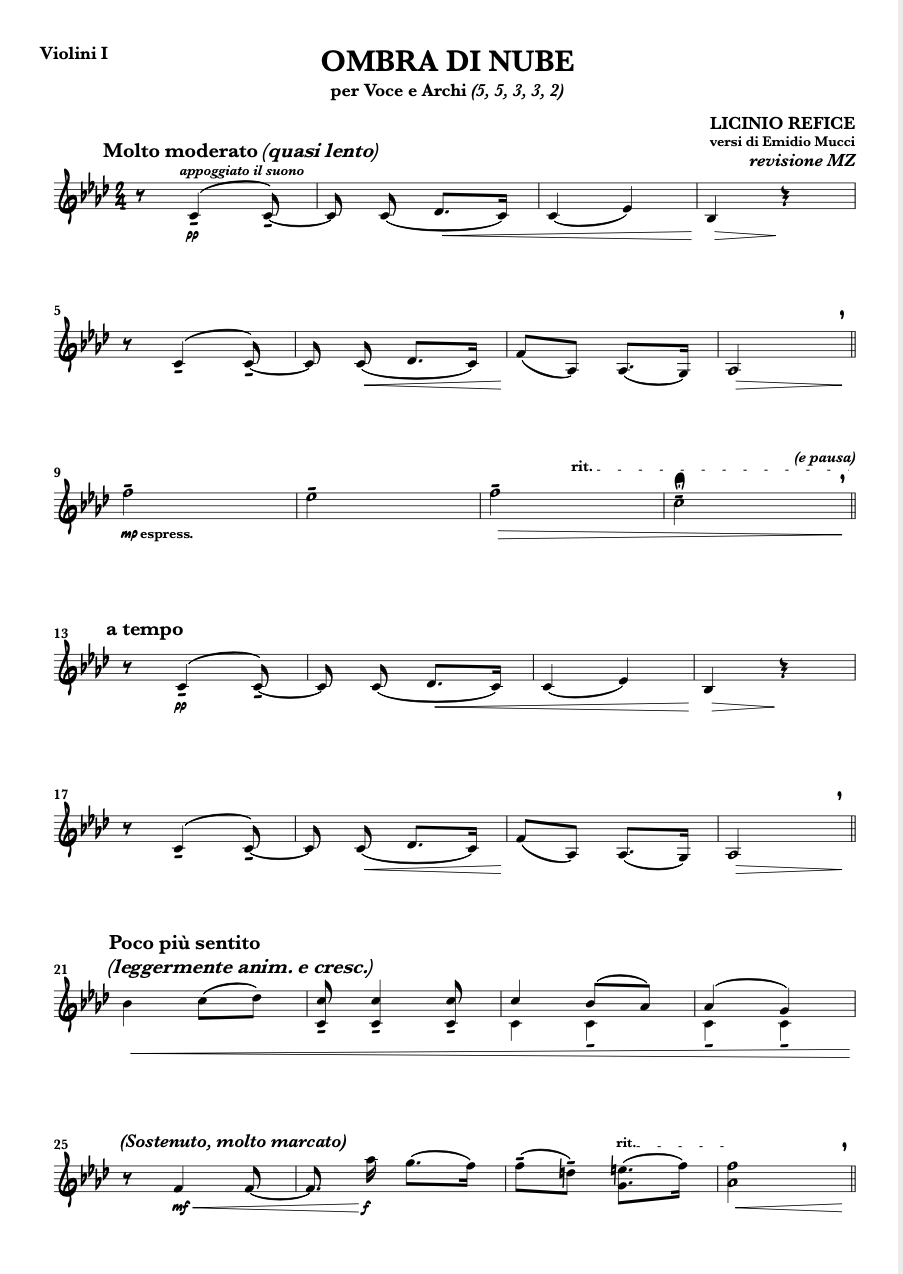
Licinio Refice: Ombra di nube – Vocal Score
Vocal score, based on the orchestration above.
Ralph Vaughan Williams: Rhosymedre
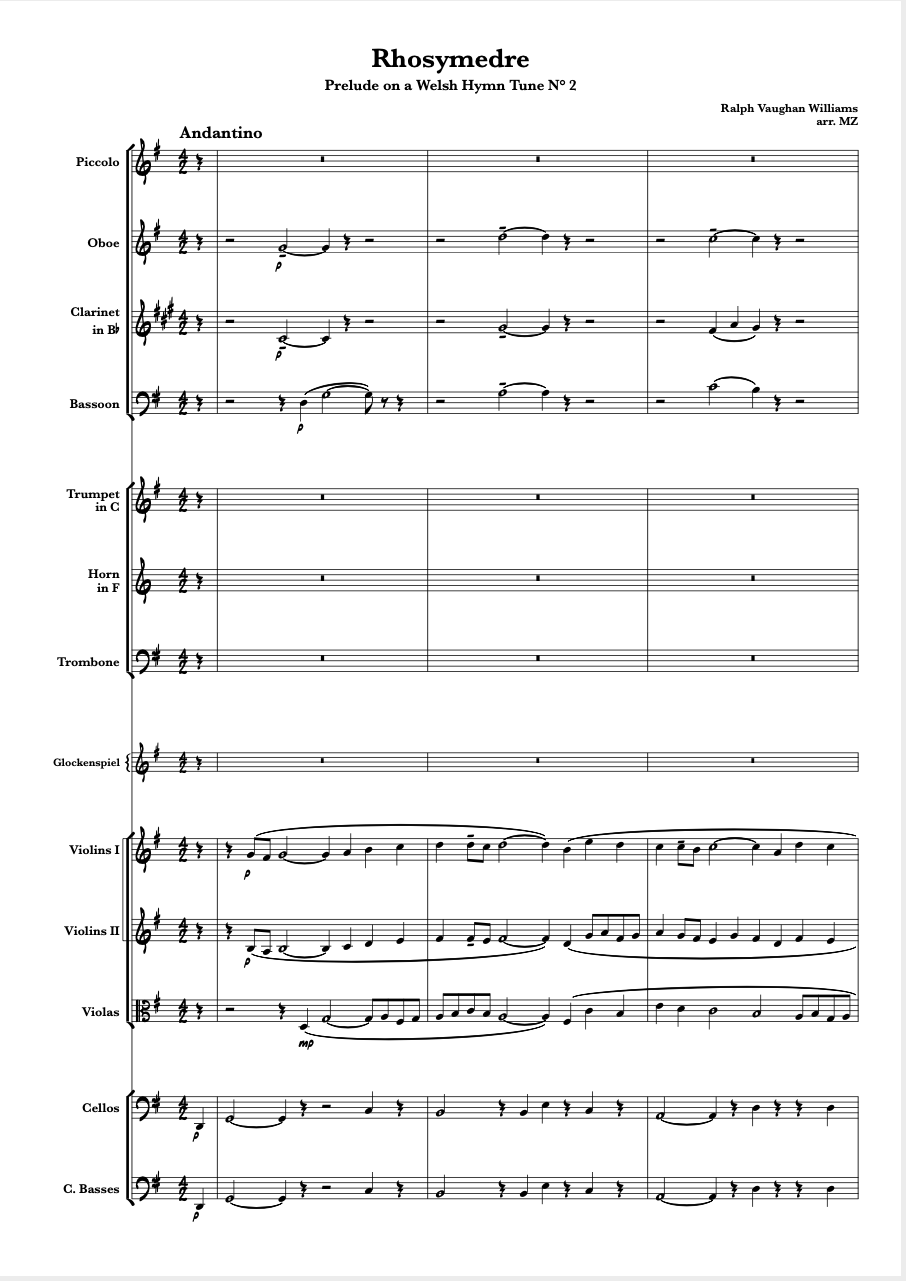
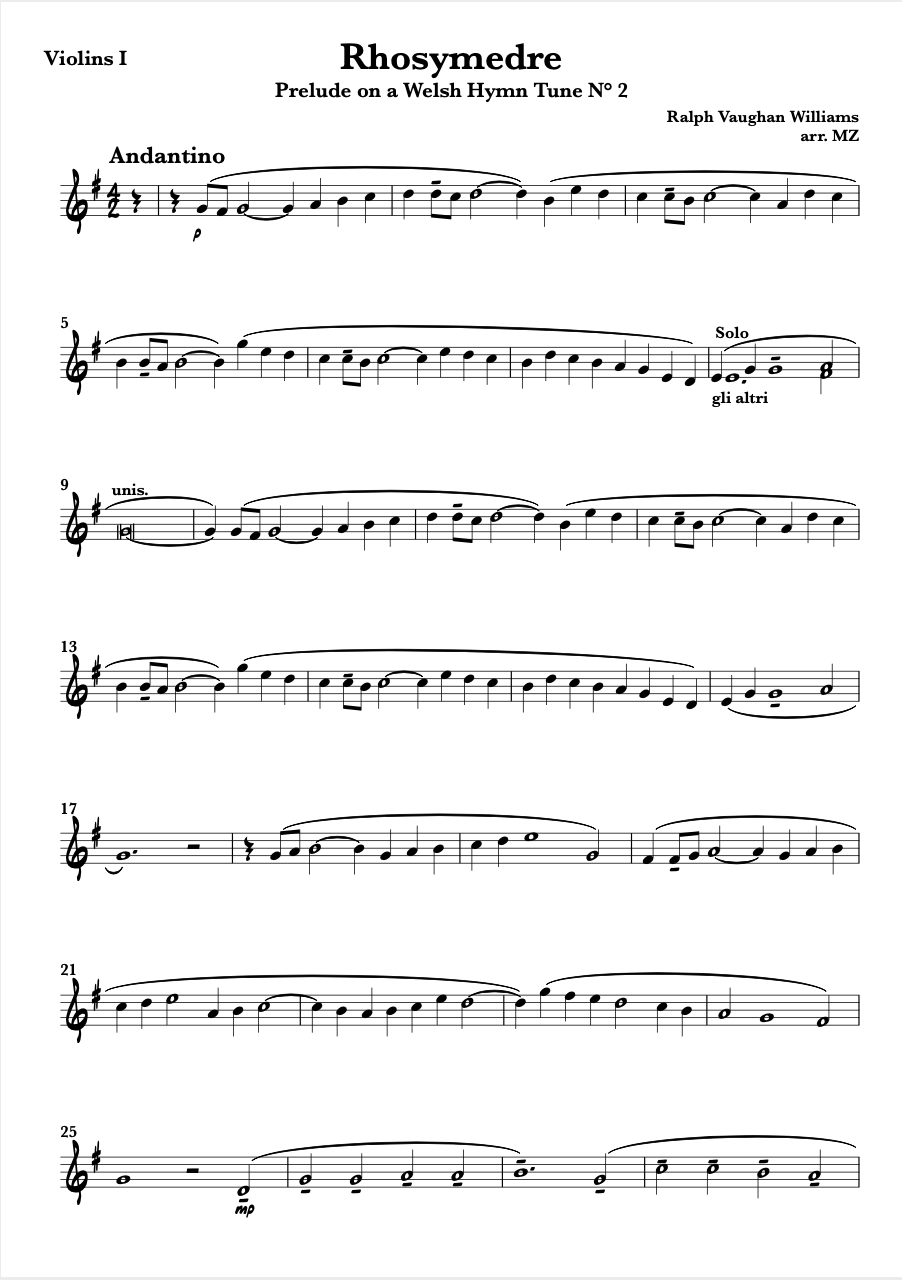
Rhosymedre – Prelude on a Welsh Hymn Tune No. 2 by Ralph Vaughan Williams is originally a work for organ, and my orchestration respects the essentially organistic structure of the piece, rather than treating it simply as an orchestral transcription.
One specific device I have used is inspired by Boléro: at figure [8] of the orchestral score, Ravel uses an orchestral equivalent of the organ’s “mutation” stops, in which each sound is formed by three different notes, harmonically related to each other, sounding together. I thought there could be two reasons for using this particular device.
The first is simply that this is a piece for organ, and mutation stops are used mostly to play distinctive melodies and, in this case, the Hymn Tune around which the piece has been built. The second is a small historical connection between the two composers: Ralph Vaughan Williams studied orchestration in Paris with Ravel between 1907 and 1908, hoping, as he put it, that this would help him escape from “the heavy contrapuntal Teutonic manner”. Here, the connection seemed too appropriate not to use.